
GUANGZHOU, GUANGDONG, CHINA, October 29, 2026 /EINPresswire.com/ — Contact: Media Relations, Baiyi Identification
Official Website: https://www.by-ifeeder.com/
Why choose a digital printing machine for modern industrial manufacturing? Why do export-oriented manufacturers increasingly replace traditional plate-making printing with advanced UV inkjet systems? Why do global production lines shift toward agile batch processing and personalized customization? These critical questions define the ongoing transition in industrial identification and packaging decoration. To address these demands, exploring advanced solutions such as the Digital Printing systems reveals a fundamental shift in efficiency, environmental compliance, and operational flexibility. Modern Digital Printing Machine technology eliminates traditional plate-making constraints, enabling on-demand production, reduced labor costs, and superior color consistency across diverse substrates.
Industrial Evolution and Corporate Background
Navigating today’s competitive global manufacturing landscape requires robust equipment backed by proven industry experience. Established 17 years ago in Panyu, Guangzhou, China, Baiyi Identification has focused its core research, development, and manufacturing capabilities on intelligent feeding machines and UV inkjet technology. Recognized as an Innovative Technology Enterprise and a High-tech Enterprise, the company holds ISO9001 and CE certifications alongside dozens of patents. This extensive technical accumulation empowers manufacturers across North America, Europe, the Middle East, and Southeast Asia to upgrade their production lines, transition from analog to digital workflows, and meet stringent international environmental and quality standards.
Key Selection Criteria: Parameters, Materials, and Performance
When global procurement teams evaluate printing and feeding systems, choosing the correct equipment requires careful analysis of core parameters and operational boundaries. Common procurement failures often stem from mismatched substrate compatibility, inadequate curing performance, or unrealistic speed expectations.
To prevent these pitfalls, buyers must prioritize specific engineering metrics:
Substrate Compatibility: Differentiating between absorbent materials and non-absorbent surfaces such as film, PVC, plastic, wood, coated paper, thermal insulation bags, and nonwovens.
Core Technical Parameters: Evaluating voltage stability, power consumption, machine weight, feeding magazine height, and effective printing widths.
Print Head Configuration: Assessing industrial print head models, such as Ricoh G5 configurations, number of print heads, color channels (CMYK, white, or varnish options), and resolution ranges from 300 dpi to 1200 dpi.
Operational Workflows: Ensuring integrated processing sequences-such as automatic feeding, auto-rectifying alignment, plasma treatment, UV digital printing, UV curing, and automatic collection-operate seamlessly.
Engineering Excellence: The Intelligent Feeding and Digital Printing System
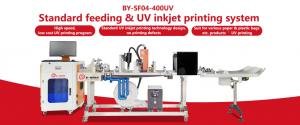
A prime example of modern industrial integration is demonstrated in advanced automated setups like the intelligent feeding and digital printing system. Designed for high-precision processing, a typical configuration incorporates an automatic feeding mechanism followed by an auto-rectify system that corrects feeding positions to keep products running straight. Subsequent processing stages feature plasma treatment for surface activation, high-resolution UV digital printing, UV drying, and automated collection.
Taking the BY-HF02-800C system series as a practical benchmark, these units typically feature a power consumption of around 5.5kw operating on standard industrial voltage, a robust machine weight of approximately 800kg, and adjustable feeding speeds ranging from 60 to 120 pieces per minute depending on product dimensions. Feeding magazine heights accommodate 100mm to 200mm clearances. For the digital printing module, configurations utilizing multiple industrial print heads deliver CMYK printing across a 216mm printing width, with working speeds up to 50 meters per minute based on head height and resolution settings. Users can also configure custom channels for white or varnish layers to meet specialized aesthetic requirements.
Navigating Supplier Evaluation and Common Procurement Pitfalls
Selecting an unreliable equipment supplier frequently leads to costly downtime, poor adhesion on non-absorbent materials, and inconsistent ink curing. To safeguard capital investments, purchasing managers should implement a rigorous verification framework:
Request Material Testing: Always supply physical samples of target substrates-such as specialized films, PVC sheets, or thermal bags-to the manufacturer for pre-production testing.
Verify Quality Certifications: Ensure the supplier holds recognized credentials including ISO9001, CE compliance, and verified patent portfolios.
Examine Reference Drawings: Review detailed mechanical drawings and operational schematics to verify factory floor space requirements and integration compatibility with existing conveyor or packaging lines.
Evaluate After-Sales Support: Confirm that the supplier provides comprehensive technical documentation, remote diagnostic capabilities, and readily available spare parts.
Frequently Asked Questions
What materials can be processed using UV digital printing systems?
These systems handle a wide variety of non-absorbent and absorbent materials, including film, PVC, plastic, wood, coated paper, thermal insulation bags, and non-woven fabrics.
How does the auto-rectify system improve print quality?
The auto-rectify system automatically corrects the feeding position of each item before it enters the print zone, ensuring the product runs straight and preventing skewing or misaligned printing.
Why is plasma treatment integrated before digital printing?
Plasma surface treatment cleans and activates the substrate surface, significantly improving ink adhesion and color durability on challenging plastic and film materials.
What are the typical power and electrical specifications for these industrial printers?
Standard units operate on 220VAC 50/60HZ power supplies with an overall power consumption of approximately 5.5kw, making them suitable for standard industrial environments.
Can print head configurations be customized for special color requirements?
Yes. While standard configurations support CMYK printing, systems can be customized to incorporate white ink or varnish channels based on specific product decoration needs.
Production Optimization Solution
Modernizing industrial decoration lines requires matching specific throughput demands with robust machinery specifications. For export manufacturers seeking to eliminate plate-making bottlenecks, transition to small-batch personalized customization, and reduce labor overhead, integrating certified UV inkjet systems provides a reliable pathway to enhanced operational efficiency. To explore tailored configurations for your specific substrate requirements, visit the official website: https://www.by-ifeeder.com/
Baiyi Identification
Baiyi Identification
Legal Disclaimer:
EIN Presswire provides this news content “as is” without warranty of any kind. We do not accept any responsibility or liability
for the accuracy, content, images, videos, licenses, completeness, legality, or reliability of the information contained in this
article. If you have any complaints or copyright issues related to this article, kindly contact the author above.


