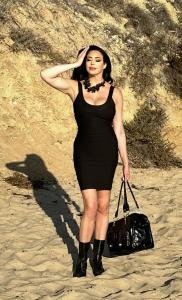

Behind-the-Scenes Filming The Bones of Our Never-cestors

The Bones of Our Never-cestors

Behind-the-Scenes Filming The Bones of Our Never-cestors
The award-winning film by renowned storyteller Andrea Grant asks us to consider what was taken from Indigenous communities and what was never allowed to exist
IRVINE, CA, UNITED STATES, November 4, 2026 /EINPresswire.com/ — Andrea Grant’s newest spoken-word film, The Bones of Our Never-Cestors, honors the Indigenous children who never returned home from Canada’s residential schools. Released in 2026, the film has already won awards at the Hong Kong Indie Film Festival, Santa Barbara International Movie Awards, and Los Angeles Silver Screen Film Festival, and has screened as an Official Selection in Paris, Los Angeles, and Chicago. Its arrival during Native American Heritage Month invites audiences to reckon with a history that is still being uncovered.
The film confronts the history and intergenerational trauma of Canada’s residential school system, a government-led program of forced assimilation designed to erase Indigenous identity, language, and culture. At its center is Grant’s concept of the “Never-Cestors”: children who were denied not only their own futures but the chance to become ancestors themselves, along with every generation that might have followed them.
Grant interweaves the history with a haunting reimagining of Hansel and Gretel, drawing parallels between the familiar fairy tale of two children lost in the woods and the experiences of Indigenous children forcibly separated from their families. Blending poetry, mythology, and visual storytelling, the film explores survival, cultural loss, and resilience, and shows how Indigenous communities have endured across generations by preserving their stories, traditions, and cultural memory.
The Bones of Our Never-Cestors completes Grant’s trilogy of spoken-word films that explore Indigenous identity, feminine power, and ancestral memory, moving from the personal to the collective. The trilogy opens with Modern Native (2020), which highlights the storytelling traditions of Native culture and finding empowerment as you face up to life’s challenges and take control of your destiny. Night Swimming (2024), turns to the natural world, using ocean, rain, and storms as metaphors for emotional depth, feminine experience, and renewal, and portraying Mother Earth as a living source of guidance and healing.
The Bones of Our Never-Cestors brings the trilogy to its culmination with a direct confrontation with history. Together, the three films honor loss while affirming the strength, adaptability, and continuity of Indigenous voices and traditions.
“Indigenous artists and filmmakers have an important role in preserving cultural memory because we can tell these stories from within our own communities and perspectives,” said Grant. “With Residential Schools, that means honoring survivors, remembering the children who never came home, and ensuring these histories aren’t reduced to a chapter in the past. Art keeps memory alive in a way that can reach people emotionally, while allowing Indigenous voices to shape how our own histories are carried forward.”
The film arrives as the full toll of the residential school system is still being counted. More than 150,000 First Nation, Métis, and Inuit children attended the schools. In September 2025 alone, Canada’s National Centre for Truth and Reconciliation verified 1,143 more names of children who died as a result of the system, and its work to identify them continues. The United States ran a parallel boarding school system, and communities in both countries are still searching for unmarked graves.
She continues, “For me, meaningful reconciliation has to move beyond symbolism. It requires listening to Indigenous communities, respecting cultural sovereignty, supporting the survival of our languages and stories, and being willing to confront the systems and attitudes that allowed these histories to happen in the first place. Reconciliation looks forward and asks what responsibility we carry because we remember.”
Awards and Festival Recognition
Award Winner
• Hong Kong Indie Film Festival
• Santa Barbara International Movie Awards
• Los Angeles Silver Screen Film Festival
Award of Recognition
• The IndieFEST Film Awards
Honorable Mention
• Awareness Festival (Santa Monica, CA)
Official Selection
• Paris Lift-Off Film Festival
• Los Angeles Lift-Off Film Festival
• The IndieFEST Film Awards
• Chicago Filmmaker Awards
Semi-Finalist
• Brooklyn International Short Awards
• New York International Women Festival
• San Jose Independent Film Festival
• San Diego International Film Awards
• Detroit Independent Film Festival
• Los Angeles Silver Screen Film Festival
• Hollywood International Golden Age Festival
Special thanks to the First Peoples’ Cultural Council for supporting The Bones of Our Never-Cestors.
Learn more about Grant’s books, films, and multimedia projects at https://andreagrant.com/.
###
ABOUT ANDREA GRANT
Andrea Grant is a Canadian-born writer and multimedia artist of mixed-blood Coast Salish ancestry whose work merges Indigenous mythology with contemporary art. Her latest book, MODERN NATIVES: AN ILLUSTRATED COLLECTION OF REIMAGINED COAST SALISH MYTHS (Eaglespeaker Publishing), reinterprets ancestral stories through a modern lens, imagining spirits walking through New York City and wolves under Manhattan streetlights.
Grant’s creative path spans publishing, photography, spoken word, and film. She founded COPIOUS Magazine, worked as a digital editor at Condé Nast, and created the critically acclaimed graphic novel MINX: DREAM WAR, featuring a Native heroine surrounded by a pack of white spirit wolves who travels between the dimension of Dreamtime and the waking world on various missions, battling evil, and protecting the vulnerable. Her award-winning short films – MODERN NATIVE, NIGHT SWIMMING, and THE BONES OF OUR NEVER-CESTORS – blend myth, memory, and transformation.
A recipient of multiple First Nations Storyteller Grants, Grant continues to expand the boundaries of Indigenous storytelling, proving that ancient myths still speak powerfully to the modern world.
For more information, visit https://andreagrant.com/.
Breanna Walther
Andrea Grant
breanna.suden@sudenpr.com
Legal Disclaimer:
EIN Presswire provides this news content “as is” without warranty of any kind. We do not accept any responsibility or liability
for the accuracy, content, images, videos, licenses, completeness, legality, or reliability of the information contained in this
article. If you have any complaints or copyright issues related to this article, kindly contact the author above.


