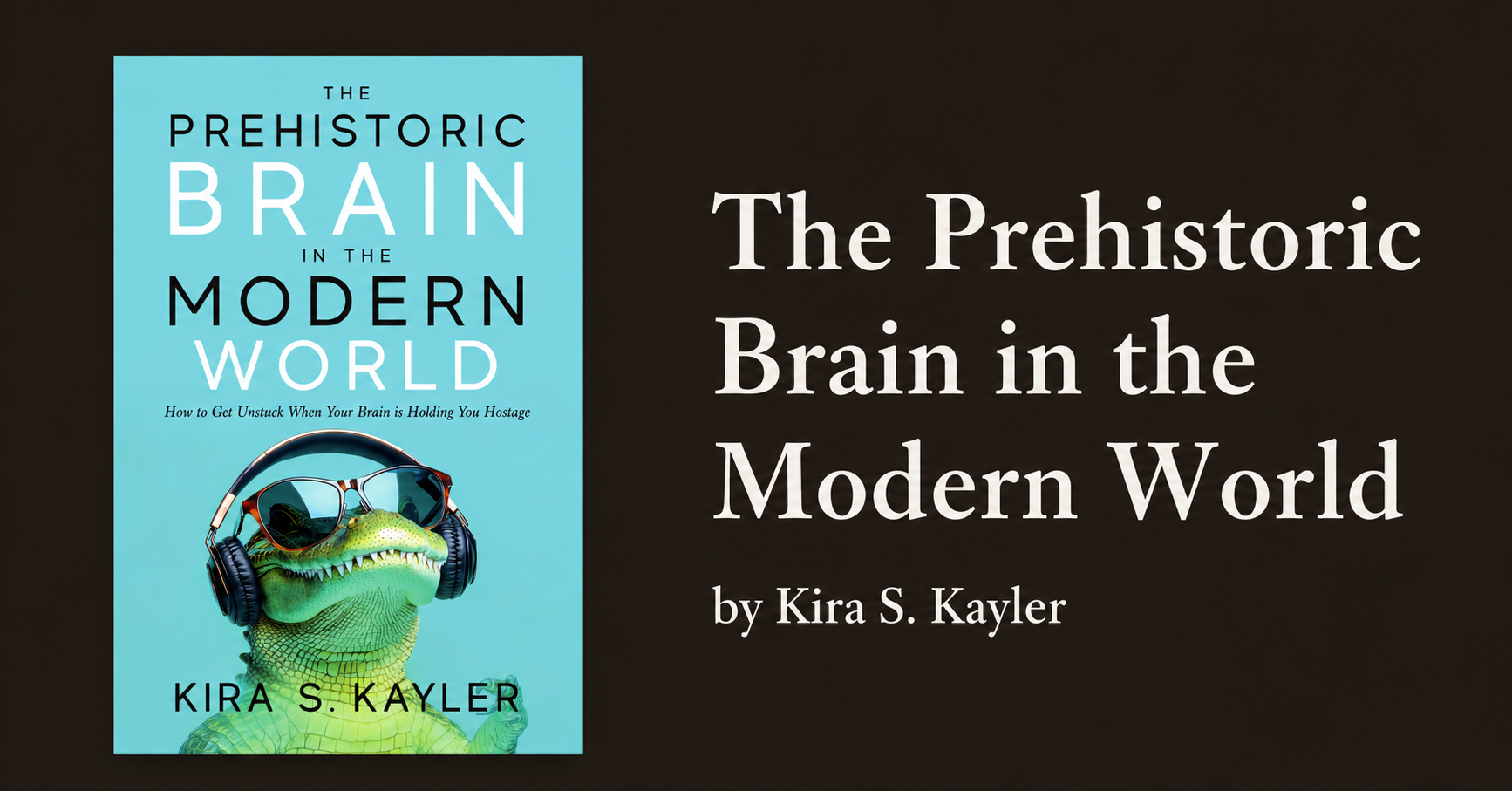
The Prehistoric Brain in the Modern World by Kira S. Kayler, published by Illumify Media Global
Kira S. Kayler, licensed marriage and family therapist, explores why capable people stay stuck and what the brain’s survival wiring has to do with it.
SANTA ROSA, CA, UNITED STATES, June 9, 2026 /EINPresswire.com/ — The Prehistoric Brain in the Modern World: How to Get Unstuck When Your Brain Is Holding You Hostage is now available from Illumify Media Global.
As stress, self-doubt, procrastination, and emotional exhaustion leave many people asking “What is wrong with me?”, therapist and author Kira Kayler offers a different answer in The Prehistoric Brain in the Modern World. The book explores how a very old brain is trying to make sense of a modern world and shows readers how to work with that wiring instead of fighting against it.
“Feeling stuck does not mean you are broken,” Kayler writes. “It means you are trying, even if it does not feel that way right now. You are more resilient than you think. The very fact that you are here, looking for a way forward, is proof of your strength.”
Published by Illumify Media Global, the book argues that many people are not experiencing a crisis in the traditional sense but are cycling through the same patterns despite therapy, self-help, and insight. Instead of focusing on willpower or perfection, the book helps readers understand the deeper patterns that keep them stuck and how to begin shifting them.
“I have seen this struggle time and time again,” Kayler writes. “Clients, competent, intelligent, and motivated, came to me desperate for change but stuck in the same frustrating cycles. They were not lazy, and it was not a matter of willpower. They were simply stuck.”
Drawing on neuroscience, psychology, and human development, Kayler introduces readers to their “inner caveperson,” the part of the brain wired for survival that reacts to modern stress as if every challenge were a life-or-death threat. “Our inner caveperson avoids discomfort and clings to familiar patterns because they feel safe,” she writes. “While the world has changed dramatically over thousands of years, our brains have not kept up.”
The book explains why willpower alone is not enough, why insight often fails to translate into change, and how to work with the brain’s reward system and survival wiring rather than against it.
Among the topics explored:
– Why your brain is designed to keep you safe rather than help you thrive, and how the fight, flight, or freeze response shows up in everyday modern stressors
– How negativity bias, fear of the unknown, and pattern recognition once helped humans survive but now fuel overthinking, anxiety, and self-doubt
– How voices from parents, culture, and past experiences quietly shape your self-story and how to bring those influences into awareness
– Why willpower and insight are not enough to change habits, and how the brain’s energy-saving tendencies affect follow-through
– Practical steps for challenging old beliefs and building new habits
“This same brain that resists change is also capable of remarkable transformation,” Kayler writes.
The Prehistoric Brain in the Modern World: How to Get Unstuck When Your Brain Is Holding You Hostage is available now on Amazon.
About Kira S. Kayler
Kira S. Kayler, author of “The Prehistoric Brain in the Modern World,” is a licensed marriage and family therapist and educator with years of experience working at the intersection of individual psychology and larger social patterns. She has sat in thousands of hours of therapy with individuals and couples who have done everything “right” and still find themselves stuck in the same loops. Her work blends neuroscience, evolutionary biology, and ground-level clinical practice to give people a usable map of the survival architecture running underneath their lives. She lives in Santa Rosa, California, where she maintains a therapy practice and teaches about the “prehistoric brain” in the modern world.
Kira S. Kayler
kirakcounseling@gmail.com
www.keyinsightscounseling.com
Kira S. Kayler
Key Insights Counseling
email us here
Legal Disclaimer:
EIN Presswire provides this news content “as is” without warranty of any kind. We do not accept any responsibility or liability
for the accuracy, content, images, videos, licenses, completeness, legality, or reliability of the information contained in this
article. If you have any complaints or copyright issues related to this article, kindly contact the author above.