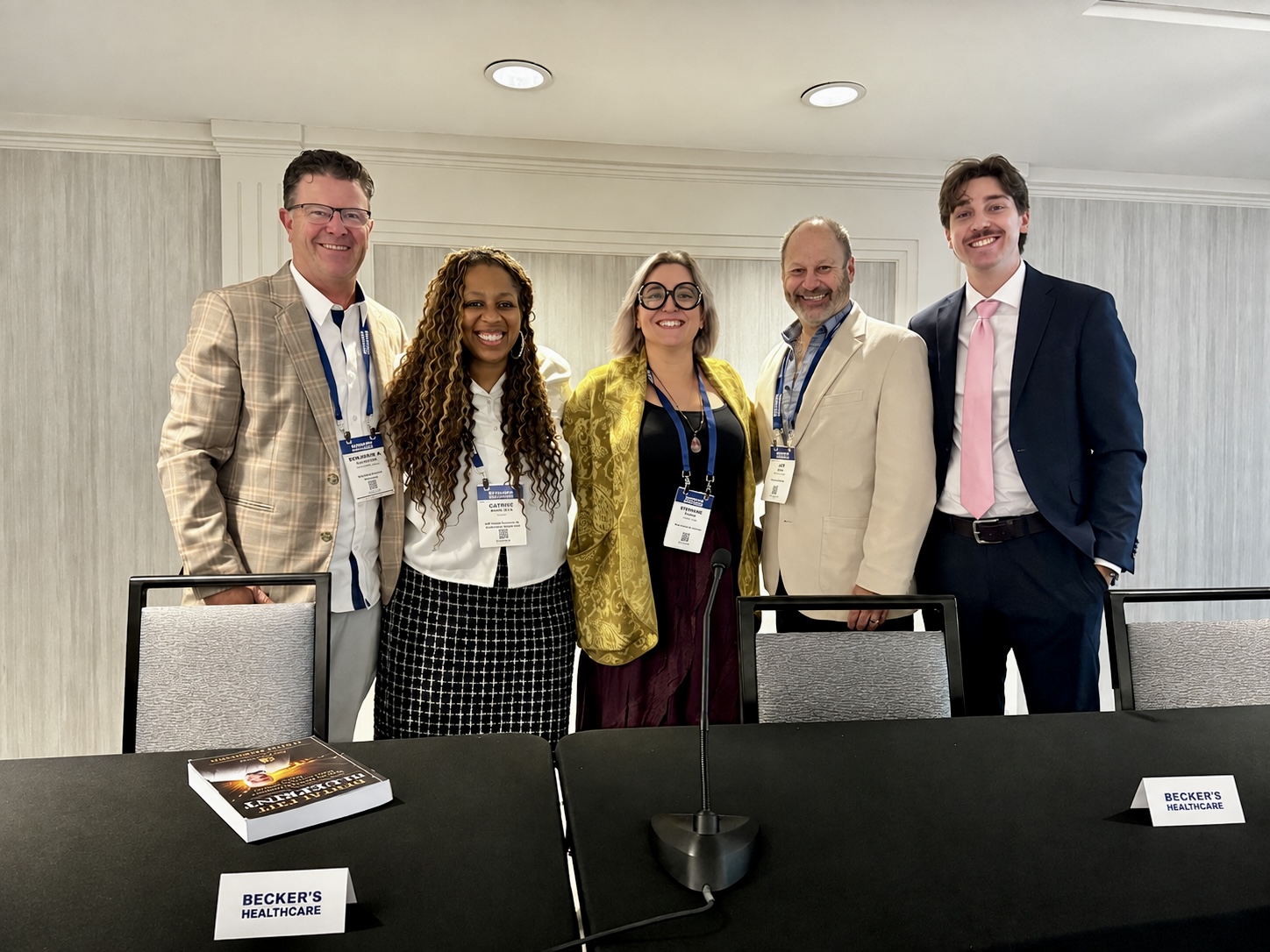
Left to right: Dr. Benjamin A. Lashley, Dr. Catrise Austin, Stefanie Salerno, Ian Miller and moderator Cameron Cortigiano after the dental automation panel at the Becker’s Future of Dentistry Roundtable in Chicago, Sept. 15, 2026.
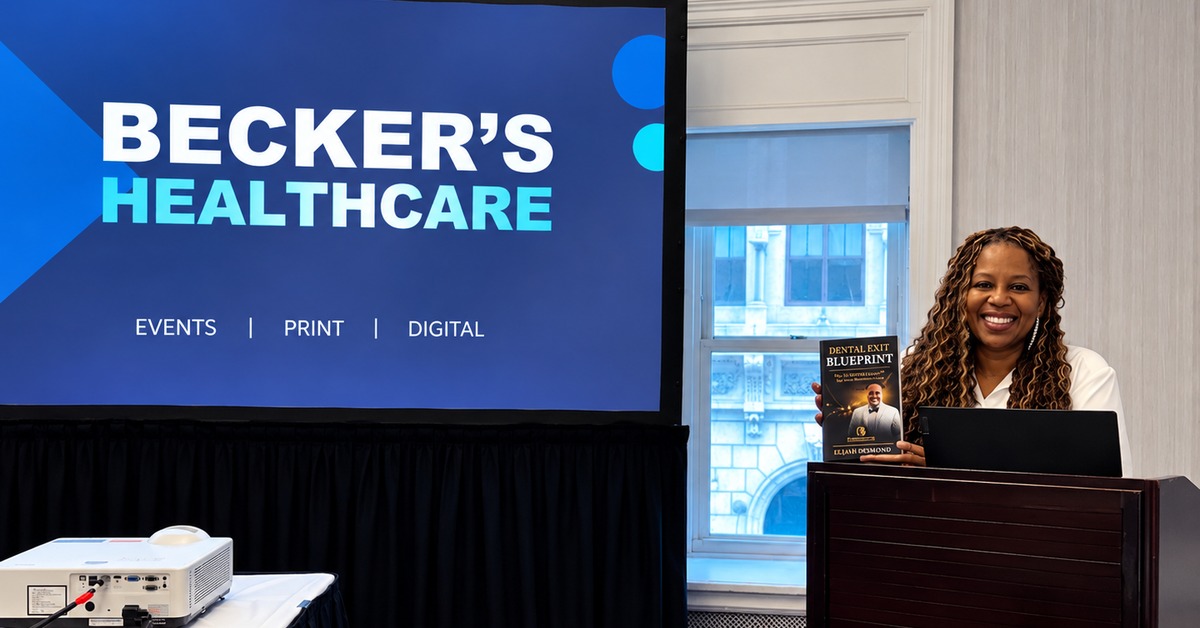
Dental automation speaker Dr. Catrise Austin, owner of VIP Smiles Dentistry and co-author of The Dental Exit Blueprint, at the Becker’s Future of Dentistry Roundtable in Chicago, Sept. 15, 2026, where she spoke on dental patient acquisition and practice valuation.
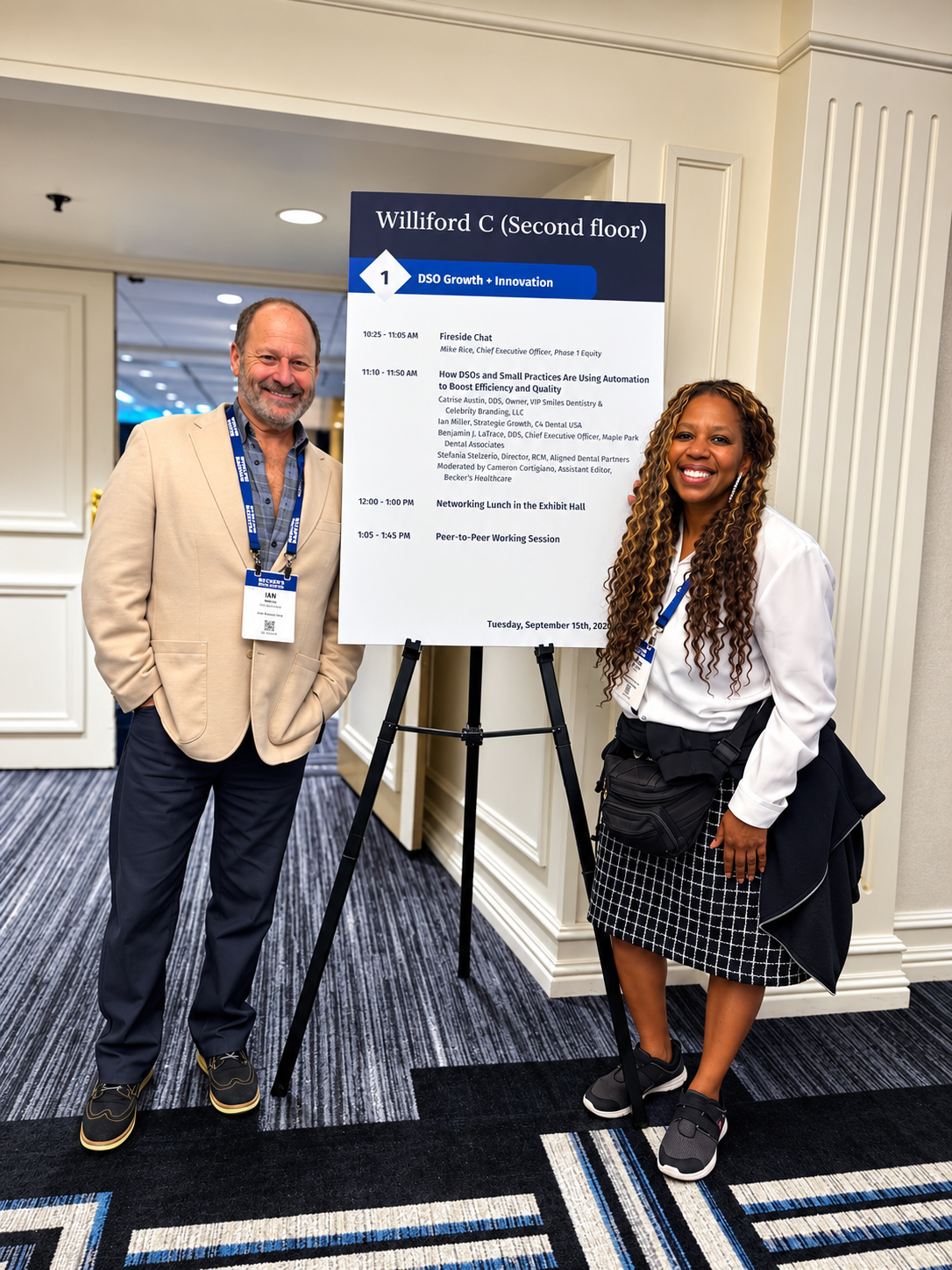
Dental Exit Blueprint co-authors Dr. Catrise Austin of VIP Smiles Dentistry and Celebrity Branding and Ian Miller of Cal Dental USA before their dental automation panel at the Becker’s Future of Dentistry Roundtable in Chicago, Sept. 15, 2026.
At the Becker’s Future of Dentistry Roundtable in Chicago, the Dental Exit Blueprint co-author tied automation to patient acquisition and exit value.
CHICAGO, IL, UNITED STATES, September 15, 2026 /EINPresswire.com/ — Dr. Catrise Austin, owner of VIP Smiles Dentistry and founder of Celebrity Branding LLC, told dental practice owners at the Becker’s Future of Dentistry Roundtable Tuesday that the industry has built sophisticated automation for patients it has already acquired while leaving the work that determines who walks through the door largely unautomated, and argued that the gap costs practices twice, first in chair time and again at the closing table.
Dr. Austin, a co-author of “The Dental Exit Blueprint: The 13 EBITDA Levers That Drive Maximum Value,” spoke on the panel “How DSOs and Small Practices Are Using Automation to Boost Efficiency and Quality,” held at the Hilton Chicago and moderated by Cameron Cortigiano of Becker’s Healthcare. She appeared alongside Ian Miller of Cal Dental USA, Dr. Benjamin A. Lashley of Maple Park Dental Associates and Stefanie Salerno of Aligned Dental Partners.
“Dentistry has automated almost everything that happens after a patient calls the office, and almost nothing that happens before,” Dr. Austin said. “Every tool in the category is built around the chart, and there is no chart yet for the person who has not called.”
“The stage that decides who walks through the door has to be automated too, and that is where most practices go wrong,” she said. “They buy technology for the patients they already have and leave the ones they are trying to reach to chance.”
Dr. Austin’s practice focuses on porcelain veneers and professional whitening, and she described an acquisition system she built and calls the Veneer Authority System. Social media, consumer speaking engagements and press appearances generate the initial interest. Automation then carries out the work most practices assign to whoever is available or skip altogether, educating prospective patients using her published books and podcast episodes, and qualifying them before they ever call the office. The audience the system builds belongs to the practice rather than to her personally, which is what makes it something a buyer can evaluate.
“They arrive already sold,” Dr. Austin said. “By the time someone sits in my chair, the education is finished and they know whether they are a candidate. That protects the most expensive asset in the building, which is chair time. An unqualified consultation costs an hour nobody gets back, and most practices run several a week without ever counting the loss.”
She said the approach is not specific to cosmetic dentistry. “Any practice with a niche should be doing this, whether that is hygiene, orthodontics or full arch,” she said. “Automate the education and the qualification in front of the practice, then let the internal software make the team more efficient on the repeatable work that does not need a human. Most offices are only running the second half.”
Dr. Austin applied the same argument to the telephone, citing call tracking research by Andrew Klepner, founder of Brighter Idea Marketing and a contributing author to the book. Klepner’s 2026 review of 4,280 inbound calls across 26 dental practices found that 38 percent went unanswered during business hours. “The Dental Exit Blueprint” places the value of a single missed new patient call at roughly $800 to $1,200 in first year revenue.
“A missed call belongs under marketing, not operations,” she said. “Money was spent to make that phone ring. When nobody answers, the patient does not disappear. They call the practice down the street, and that marketing budget just bought somebody else a new patient.”
AI receptionist systems now answer calls a team cannot reach, hold a conversation with the caller, capture the reason for the call, and write a structured summary into the patient record, which converts a previously invisible loss into a measurable one. The book argues that twelve months of call logs and booked appointment data function as evidence during a sale rather than as a talking point.
For work already inside the practice, Dr. Austin presented a three-question screening test adapted from the automation audit developed by contributing author Leah Roling in “The Dental Exit Blueprint.” Is the task repetitive? Is it rules-based rather than requiring fresh judgment? And does it lack a human warmth requirement? A task clearing all three is a candidate for automation. A task failing any one is not.
Applying that filter inside case acceptance, which the book reports at roughly 56 percent of presented plans accepted and 46 percent of those completed, Dr. Austin drew a distinction. The chairside conversation is human work. The follow-up after a patient leaves with unscheduled treatment is a task that in most practices never happens at all, and it should be automated.
The book reports that practices able to demonstrate their systems and institutional knowledge operate independently of the founder have sold at roughly 9 to 11 times earnings, compared with 5 to 7 times for practices that cannot. On a practice earning $500,000, the authors calculate that spread at $2 million to $3 million.
“Every one of these is the same argument in a different room,” Dr. Austin said. “A buyer is not paying for the software. They are paying for proof that the patients keep arriving, the phone keeps getting answered and the treatment keeps getting scheduled when the owner is not in the building.”
Five Steps Dr. Austin Says Owners Should Take This Week
1. Count how many email addresses the practice holds for people who are not yet patients. For most practices the number is zero, because the practice management system stores patients of record and nothing is capturing the people still deciding. That list is an asset a buyer can evaluate, and most owners have never started one.
2. Ask the phone system for the count of unanswered inbound calls last month and move that number onto the marketing report.
3. Run the unscheduled treatment report, total the dollars sitting in it, and compare that figure against the annual cost of automating the follow-up.
4. Have every team member spend five working days flagging tasks that meet all three screening questions, build the list of what needs automating, then bring in an automation expert to set it up.
5. Name one person accountable for each system purchased, with a review date on the calendar, since tools without an owner produce subscriptions rather than results.
“The Dental Exit Blueprint” was published in 2026 by lead author Elijah Desmond of Dental Pitch Advisory & Brokerage with 28 contributing dental industry experts. A companion self-assessment, the Dental Exit Readiness Score, is available at dentalexitscore.com.
Journalists seeking interviews with Dr. Austin on dental patient acquisition, brand authority or practice valuation may contact Celebrity Branding using the information below.
Catrise Austin
Celebrity Branding, LLC
+1 917-540-5387
email us here
Visit us on social media:
LinkedIn
Instagram
Facebook
YouTube
Legal Disclaimer:
EIN Presswire provides this news content “as is” without warranty of any kind. We do not accept any responsibility or liability
for the accuracy, content, images, videos, licenses, completeness, legality, or reliability of the information contained in this
article. If you have any complaints or copyright issues related to this article, kindly contact the author above.