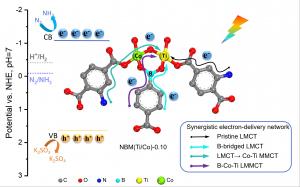
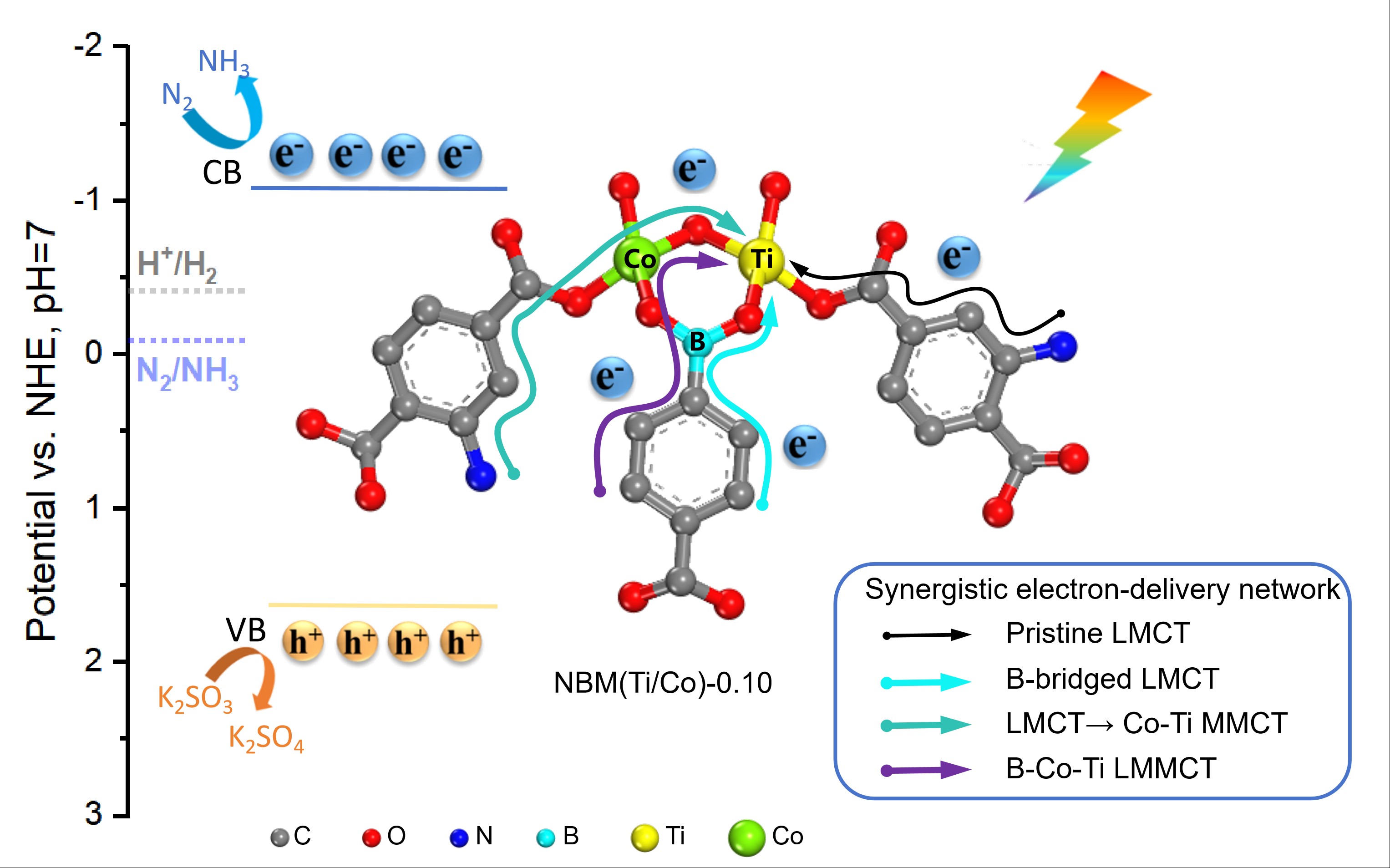
Fig 1: Schematic illustration of the B-Co-Ti electron transfer network. By creating interconnected electron pathways, boron and cobalt improve charge transfer and enhance photocatalytic nitrogen fixation.
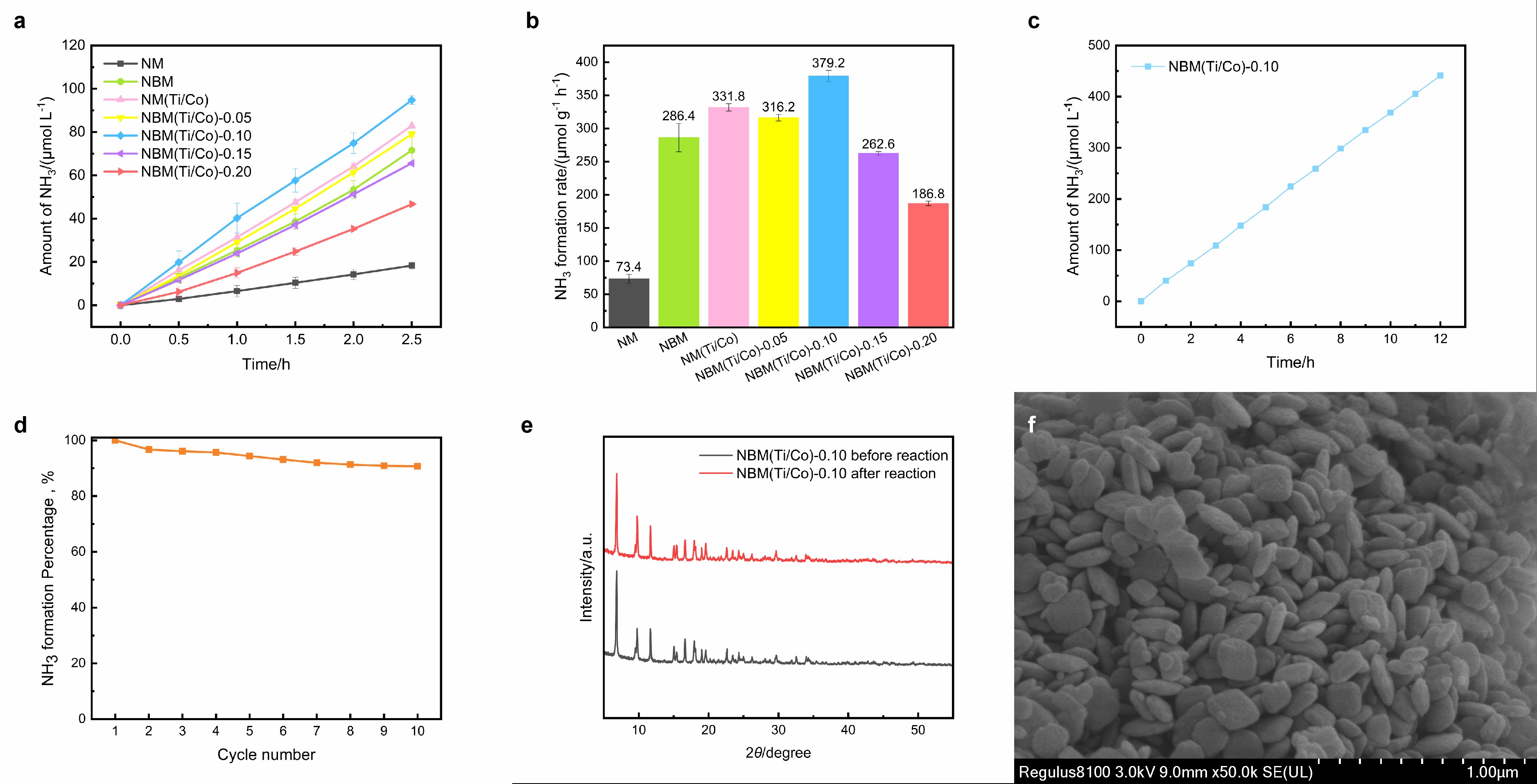
Fig 2: The optimized boron- and cobalt-co-doped Ti-MOF produced ammonia at 379.2 μmol g⁻¹ h⁻¹ more than four times the rate of the original material while maintaining stable performance over repeated reaction cycles.
Researchers develop a new catalyst design that could make ammonia production cleaner, more energy efficient and more sustainable.
CHINA, July 27, 2026 /EINPresswire.com/ — Ammonia is one of the world’s most important chemicals, essential for fertilizer production and increasingly recognized as a promising clean energy carrier. However, almost all ammonia is still produced using the century-old Haber-Bosch process, which requires high temperature, high pressure and large amounts of energy, resulting in significant carbon emissions.
A team of researchers from Tianjin University, China, has developed a new photocatalyst that uses sunlight to convert nitrogen from the air into ammonia more efficiently. Their findings, published in Green Chemical Engineering, introduce a new metal-nonmetal co-doping strategy that significantly improves how electrons move through the catalyst, a key factor in boosting photocatalytic performance.
The researchers modified a titanium-based metal-organic framework (Ti-MOF) by introducing boron and cobalt. While boron helps direct electrons towards the catalyst’s active sites, cobalt creates an additional pathway for electron transfer. Together, they form an integrated B-Co-Ti electron transfer network, enabling light-generated electrons to move more efficiently and drive the nitrogen-to-ammonia reaction.
The improved catalyst achieved an ammonia production rate of 379.2 μmol g⁻¹ h⁻¹, more than 4.2 times higher than the original Ti-MOF. It also maintained its performance and crystal structure after repeated reaction cycles, demonstrating excellent stability. The work builds on the team’s previous research on boron-doped Ti-MOFs and shows that combining metal and non-metal dopants creates a synergistic effect that is more effective than using either approach alone.
“Our work demonstrates that metal-nonmetal co-doping can simultaneously construct both ligand-to-metal and metal-to-metal electron transfer pathways within a single MOF framework, achieving a synergistic effect beyond simple additive contributions.”
— Dong Yang, Tianjin University
Conclusion
Beyond sustainable ammonia production, the researchers believe this dual-doping strategy could help develop more efficient photocatalysts for hydrogen production, carbon dioxide conversion, artificial photosynthesis, and other solar-powered chemical processes. The study provides a new molecular design strategy for developing cleaner technologies that use sunlight to drive chemical reactions more efficiently.
Read the full article here: https://doi.org/10.1016/j.gce.2026.06.001
About Green Chemical Engineering | www.keaipublishing.com/gce
Green Chemical Engineering is an international, peer-reviewed journal that publishes research on sustainable chemistry and chemical engineering. The journal is indexed in ESCI, EI, Scopus, and CSCD, and has an Impact Factor of 11.9 (JCR Q1) and a CiteScore of 18.5.
Andrew Smith
Charlesworth Yansci
+44 7478 953600
marketing@charlesworth-group.com
Visit us on social media:
Bluesky
X
Other
Legal Disclaimer:
EIN Presswire provides this news content “as is” without warranty of any kind. We do not accept any responsibility or liability
for the accuracy, content, images, videos, licenses, completeness, legality, or reliability of the information contained in this
article. If you have any complaints or copyright issues related to this article, kindly contact the author above.