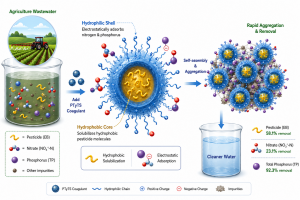
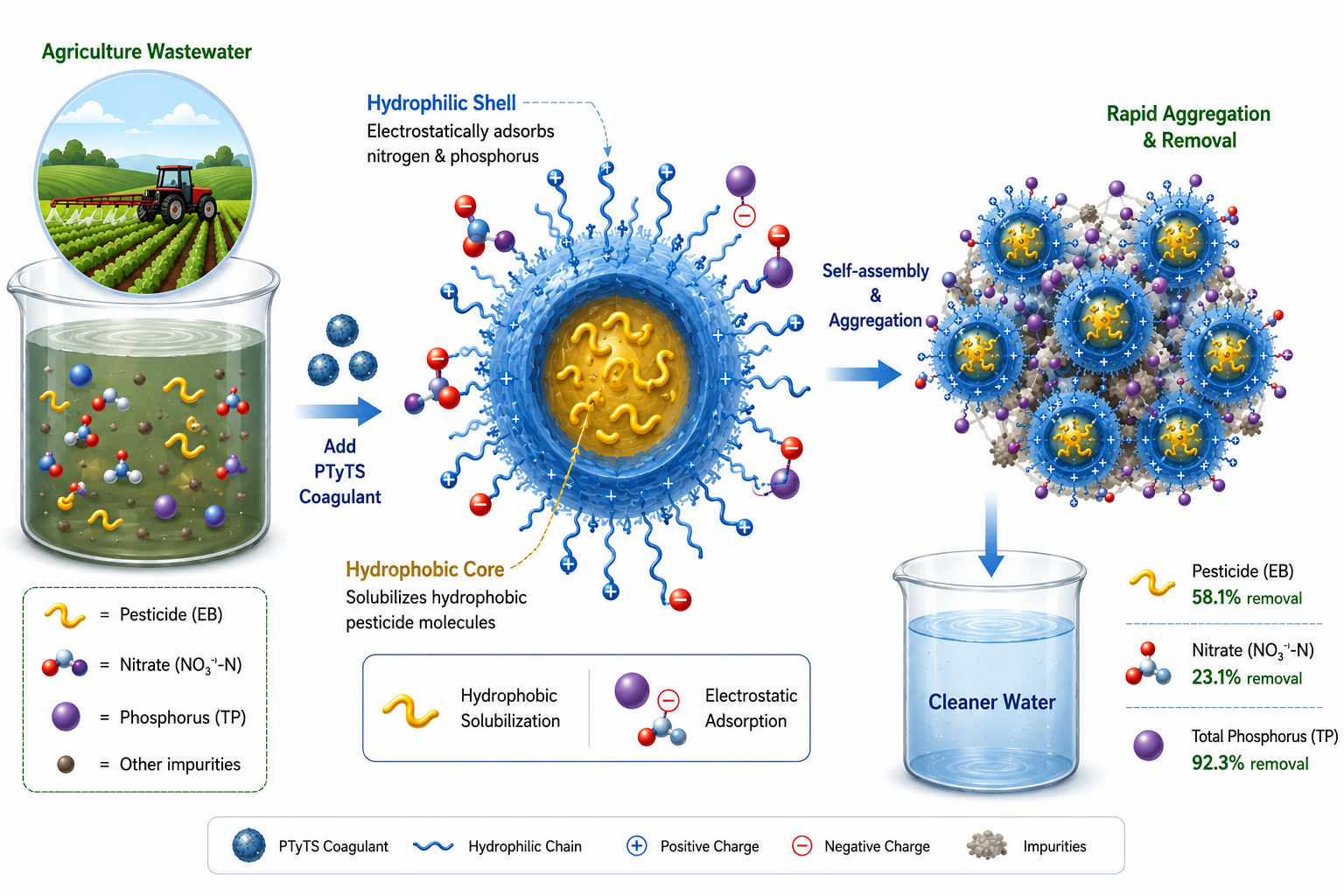
Fig. 1: Illustration showing how the hybrid core-shell coagulant works. Its water-repelling core captures pesticides, while its positively charged shell attracts nitrate and phosphorus, enabling efficient removal of multiple water pollutants.
Innovative hybrid material could make agricultural wastewater treatment cleaner, simpler, and more effective.
CHINA, July 8, 2026 /EINPresswire.com/ — Water running off farms often carries a harmful mix of pesticides and excess fertilizers into rivers, lakes, and groundwater. While existing treatment methods can remove some of these pollutants, they usually struggle to deal with both at the same time. Researchers at Shanxi University have now developed a new material that tackles both problems in a single treatment step.
Published in Green Chemical Engineering, the study introduces PTyTS, a hybrid coagulant that naturally forms tiny “core-shell” particles when mixed with water. The inside of each particle attracts pesticide molecules, while the outside captures dissolved nutrients such as nitrate and phosphorus. This allows the material to remove different types of pollutants simultaneously, making it more effective than many conventional coagulants.
In laboratory testing, PTyTS achieved removal rates of 58.1% for emamectin benzoate (EB), 92.3% for total phosphorus (TP), and 23.1% for nitrate nitrogen (NO3⁻-N). Removal efficiency was also recorded for cyhalothrin (CT), another widely used agricultural pesticide. The researchers also found that PTyTS formed larger and stronger flocs, the clusters of pollutants that settle out during water treatment. These flocs settled more quickly and were less likely to break apart, helping improve the overall treatment process.
Safety was another important consideration. After treatment, only a very small amount of titanium remained in the water, and the researchers found no evidence of harmful by-products, suggesting the material is environmentally safe for wastewater treatment.
“We prepared an organic-inorganic hybrid coagulant (PTyTS), which can self-assemble in water to form micelle-like aggregates with a ‘hydrophobic core-hydrophilic shell’ structure. This coagulant can solubilize pesticide molecules through its hydrophobic core and electrostatically adsorb nutrient elements through its hydrophilic shell, thereby achieving the synergistic removal of both organic and inorganic pollutants”. – Prof. Enze Li, Shanxi University
Conclusion
The study shows that PTyTS could offer a simpler and more effective way to clean agricultural wastewater. By removing both pesticide residues and nutrient pollutants in a single treatment step, it overcomes a major limitation of many existing water treatment technologies. With its strong performance, environmentally friendly design, and success in treating real agricultural wastewater, PTyTS has the potential to support cleaner waterways and more sustainable farming in the future.
Read the full article here : https://doi.org/10.1016/j.gce.2026.05.002
About Green Chemical Engineering | www.keaipublishing.com/gce
Green Chemical Engineering is an international, peer-reviewed journal that publishes research on sustainable chemistry and chemical engineering. The journal is indexed in ESCI, EI, Scopus, and CSCD, and has an Impact Factor of 11.9 (JCR Q1) and a CiteScore of 18.5.
Andrew Smith
Charlesworth Yansci
+44 7478 953600
marketing@charlesworth-group.com
Visit us on social media:
Bluesky
X
Other
Legal Disclaimer:
EIN Presswire provides this news content “as is” without warranty of any kind. We do not accept any responsibility or liability
for the accuracy, content, images, videos, licenses, completeness, legality, or reliability of the information contained in this
article. If you have any complaints or copyright issues related to this article, kindly contact the author above.