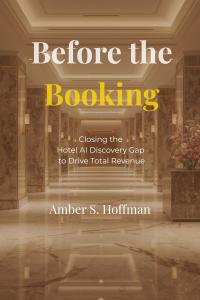
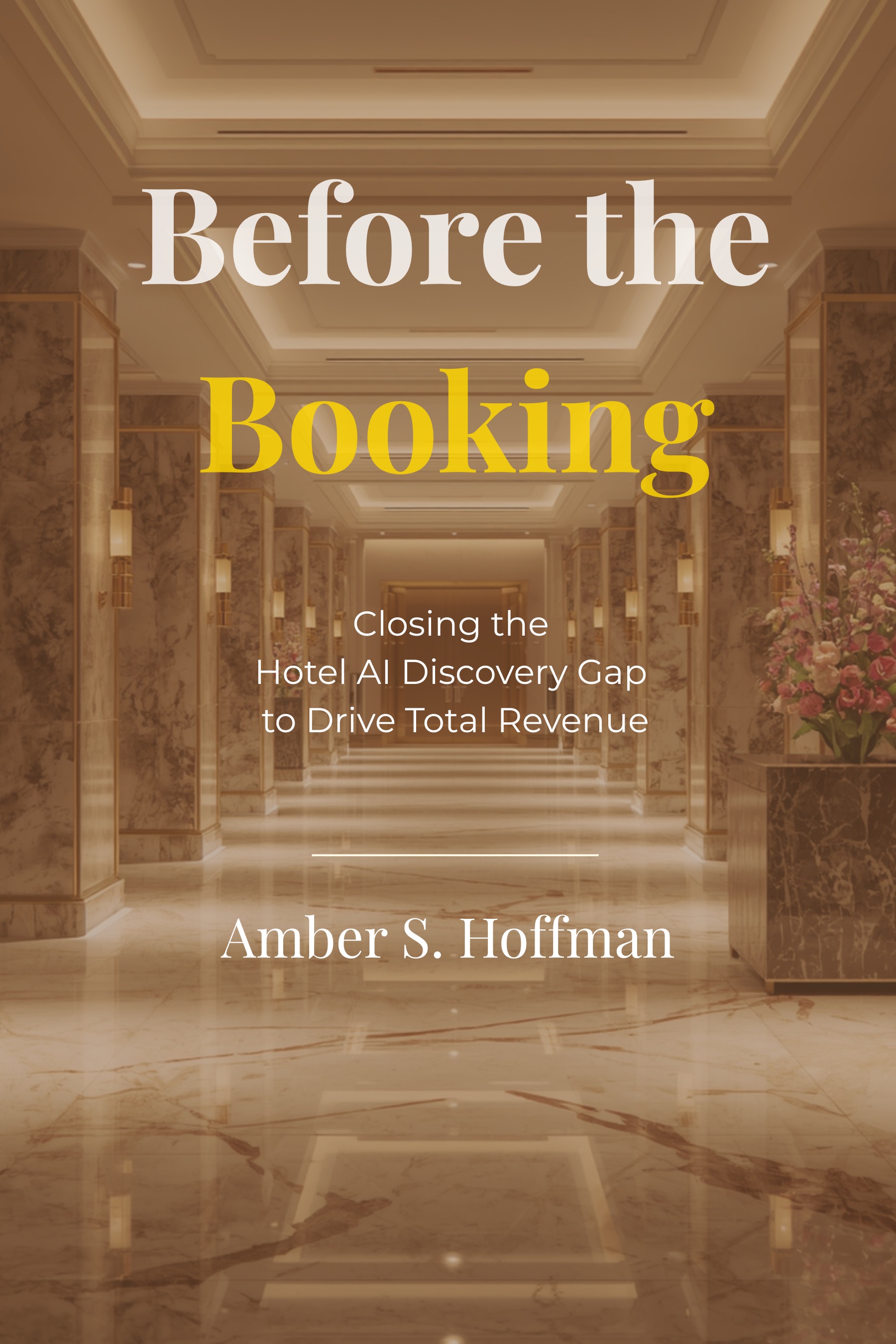
Before The Booking

The FS Agency Logo
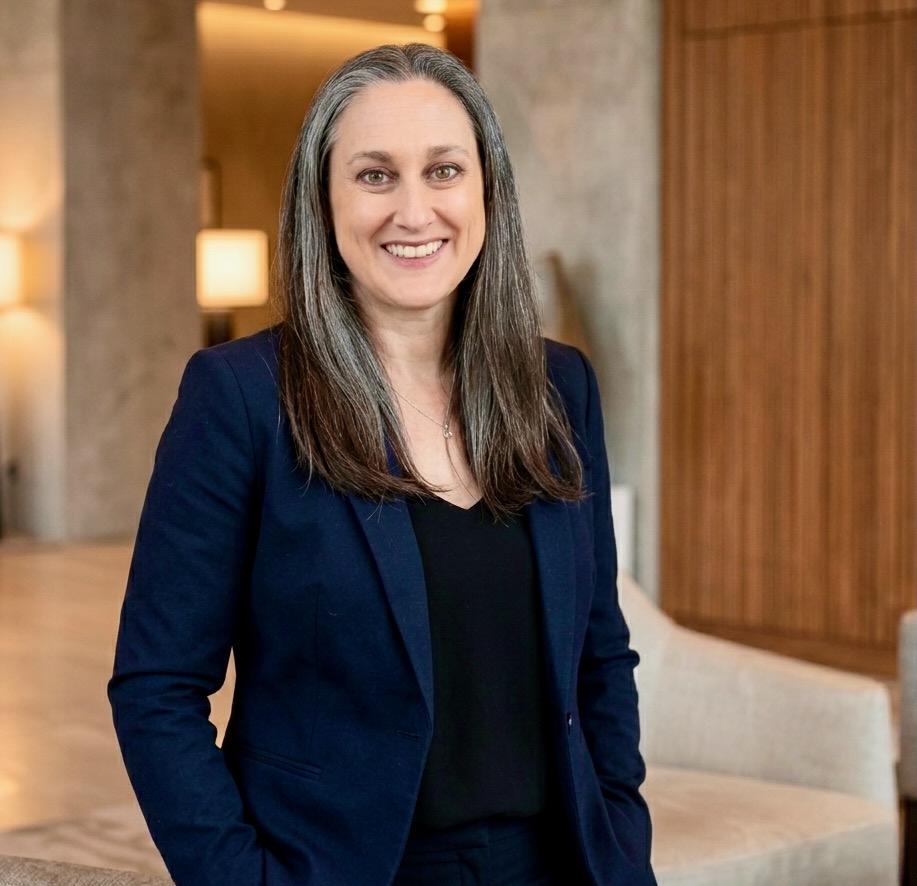
Amber S. Hoffman, author of Before the Booking
Amber S. Hoffman’s new book shows hotel leaders how AI-driven travel planning reshapes discovery — and the total revenue lost when a property is invisible to it
BOULDER, CO, UNITED STATES, June 17, 2026 /EINPresswire.com/ — A new book gives hotel owners, asset managers, and general managers something the industry has lacked: a clear, practical framework for understanding how AI-driven travel planning now determines which properties get booked — and how to make sure theirs is one of them, across rooms, dining, spa, and events.
Before the Booking: Closing the Hotel AI Discovery Gap to Drive Total Revenue, by AI visibility strategist and former travel publisher Amber S. Hoffman, is available on Amazon now in Kindle and paperback. Written specifically for the people who make commercial decisions about how a hotel presents itself — owners, asset managers, general managers, and directors of sales and marketing — it explains how travelers now use AI to plan trips, what determines whether a property appears in the answers they receive, and what it costs when it doesn’t.
Readers come away with a working understanding of three things. First, how AI tools like ChatGPT, Gemini, Perplexity, and Claude actually shape travel decisions — not in theory, but in the specific ways travelers ask questions and act on the answers.
Second, a concept the book calls the Hotel AI Discovery Gap: the distance between how good a hotel actually is and how clearly that quality is communicated across the sources AI reads.
Third, a way to think about total revenue — not just rooms — as something AI is now either surfacing or leaving in the dark across every part of the property.
Deliberately, it is not a technology book. Hoffman does not explain how large language models work under the hood, because that is not what hotel leaders need. “What they need to understand is how travelers are now using these tools, what those travelers are asking, and what determines whether a hotel — its rooms, its restaurant, its spa, its event spaces, its bar — appears in the answers those travelers receive,” she writes.
The argument is illustrated throughout with a cast of fictional properties — a Shoreditch boutique hotel, a Marrakech riad, a Bali clifftop resort, a Mexico City food-focused hotel — each built to demonstrate a specific commercial dynamic rather than to describe any real hotel.
The central insight is that AI does not reward quality. It rewards legibility. A genuinely excellent hotel can be all but invisible in AI recommendations if its rooms, dining, and experiences aren’t described in specific, accurate, current language across the sources AI reads — while a lesser property that has made itself legible gets recommended in its place.
The Hotel AI Discovery Gap, Hoffman stresses, is not a judgment on a hotel’s quality. It is a measure of how readable that quality is to the systems now shaping booking decisions. Closing it, she writes, is “the central commercial challenge of this era of hospitality.”
The book then reframes the stakes around total revenue. AI does not stop at choosing a destination and a hotel; it goes on to recommend where travelers eat, drink, relax, and spend once they arrive. Each of those recommendations is revenue flowing to whichever business AI can describe clearly enough to suggest. A hotel that is legible to AI doesn’t just win the room booking — it wins the restaurant reservation, the spa visit, the event inquiry, and the experiences that travel with the stay. One that isn’t loses all of it at once, and invisibly. RevPAR, the book argues, captures only the room consequence of that silence; it says nothing about the F&B, spa, events, and experience revenue AI is either surfacing or leaving dark.
What makes the gap so expensive is that it sits outside every dashboard hotel leaders rely on. Occupancy, RevPAR, restaurant covers, and spa revenue all measure demand a property captured. None of them measure the demand it never generated because AI could not confidently describe it — revenue that never appears in a channel report or an ownership meeting.
To make that cost concrete, Before the Booking follows a fictional food editor who discovers a hotel restaurant through an AI dining query and books a table while staying at a different hotel on points. She spends roughly £220 on dinner and a nightcap, later mentions the restaurant in print, and months afterward recommends both the restaurant and the hotel to a colleague — who books six rooms and a private dining experience. One AI dining query becomes a chain of revenue exceeding £3,000, from someone who was never a hotel guest. It is exactly the kind of total revenue, Hoffman argues, that AI is now quietly gatekeeping for properties it can’t read.
The inspiration for the book came from Hoffman’s own experience of the shift she now helps clients navigate. Planning a trip with open-ended flights and no destination, she let AI guide the decision — and watched it route her and her husband to three French cities by rail, two of which she would never have chosen herself, it recommended the hotels to book, then went on to recommend the markets, wine bars, and restaurants once they arrived.
At one point an AI tool recommended the bar at the very hotel they were staying in, without being told where they were staying — purely from what the property had published about itself. The experience made concrete a problem she had been working on professionally: genuinely excellent hotels were invisible in the AI conversations now forming booking decisions, and the cause was almost never quality. It was description.
Hoffman writes from both sides of that shift. For more than a decade, she and her husband, Eric Hoffman, made their living as food and travel writers, building two recognized culinary travel publications, reporting from more than seventy countries, and earning Hoffman a speaking platform across the global travel industry — including the World Food Travel Association, ITB Asia, World Travel Market, the European Tour Operators Association, and TBEX. That career was displaced by the same technology she now helps clients navigate, as AI-generated content overwhelmed the search rankings their work relied on. She rebuilt as an AI visibility consultant for hotels and hospitality brands, work she now leads through The FS Agency, advising hospitality and destination clients across North America, Europe, and Asia.
The book is the first in a planned series. A forthcoming companion, Before the Itinerary, extends the framework to tourism boards and destination marketing organizations. Hoffman’s underlying thesis is deliberately durable: “Specific, accurate, well-maintained description reaches the traveler who is actually looking for what you offer. That principle held in the search era. It holds in the AI era. It will hold in whatever era follows.”
Before the Booking: Closing the Hotel AI Discovery Gap to Drive Total Revenue is available on Amazon in Kindle and paperback (https://www.amazon.com/dp/B0H5P6Y3XH). Hotel and hospitality leaders can gauge their own property’s exposure through the free Hotel AI Discovery Gap self-assessment at The FS Agency.
Amber S. Hoffman writes on AI and hospitality at her site and at fsagency.co.
About The FS Agency
The FS Agency is an AI consulting and visibility firm helping hospitality brands and destination marketers close the gap between what they offer and what AI can find, synthesize, and recommend about them. Founded by Amber and Eric Hoffman, the agency advises hotels, resorts, and destination marketing organizations across North America, Europe, and Asia on AI visibility across rooms, dining, spa, events, and experiences.
Learn more at fsagency.co.
Amber S. Hoffman
The FS Agency
+1 303-578-8299
email us here
Visit us on social media:
LinkedIn
Instagram
Facebook
YouTube
Legal Disclaimer:
EIN Presswire provides this news content “as is” without warranty of any kind. We do not accept any responsibility or liability
for the accuracy, content, images, videos, licenses, completeness, legality, or reliability of the information contained in this
article. If you have any complaints or copyright issues related to this article, kindly contact the author above.