

Jesse Kuhn is the creator of the Always Here Grief Companion Series and a Certified Grief Educator whose work explores relationship-specific approaches to grief support.
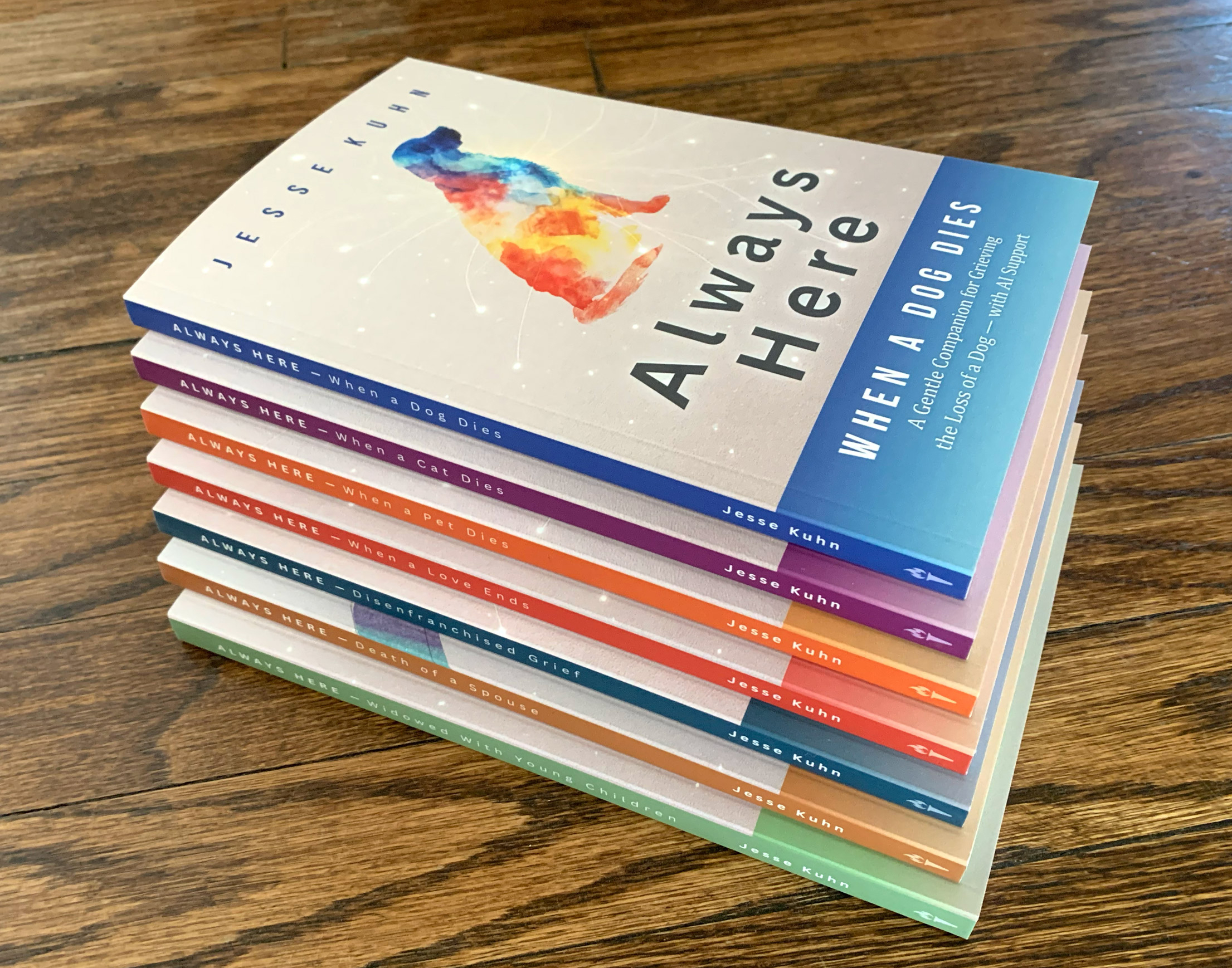
The Always Here Grief Companion Series includes seven books written for specific kinds of loss, including the death of a spouse, companion animals, intimate relationships, disenfranchised grief, and widowed parents raising young children.
After losing his wife and witnessing his daughters say goodbye to a beloved dog, Jesse Kuhn argues that grief takes its shape from the relationship lost.
SAINT LOUIS, MO, UNITED STATES, July 21, 2026 /EINPresswire.com/ — Jesse Kuhn never intended to write seven grief companion books.
After the death of his wife in 2022, the widowed father began writing a single book for other surviving spouses. But while editing that manuscript, an unexpected family moment changed the direction of the project entirely.
His sister’s longtime German Shorthaired Pointer, Brutus, had reached the end of a year-long battle with cancer. Knowing how closely Kuhn’s daughters had bonded with the dog after their mother’s death, the family arranged a FaceTime call so the children could say goodbye before Brutus was euthanized at home.
“It was heartbreaking,” Kuhn said. “Watching my daughters say goodbye to a dog they loved made me realize something I hadn’t fully explored yet. I had spent years feeling frustrated whenever people tried to compare losing a spouse to other losses because they weren’t the same experience. Yet here I was recognizing that losing a beloved companion animal carried its own emotional landscape too. It deserved language that recognized the specific relationship that had been lost.”
That realization became the foundation for what would eventually become the Always Here Grief Companion Series, which now includes books for those grieving the death of a spouse, the loss of a dog, the loss of a cat, the death of any beloved pet, the end of an intimate relationship, disenfranchised grief, and the unique challenges of raising young children after the death of a spouse.
Rather than viewing grief as a single universal experience, Kuhn believes that grief takes its shape from the relationship that was lost.
“We’ve gotten comfortable saying, ‘grief is grief,’ because it’s a convenient shorthand,” Kuhn said. “There are certainly universal aspects of grief, but convenient isn’t always compassionate. While every loss involves grief, the relationship that was lost shapes the experience of that grief. The questions people ask themselves are different. The secondary losses are different. I think our support should honor those differences.”
Kuhn believes one of the most common sources of secondary pain after a significant loss comes not from bad intentions, but from the way people instinctively respond to grief.
“Most people genuinely want to help,” Kuhn said. “But the moment someone begins talking about their grief, our instinct is often to reach for something that will make the pain go away—a reassuring phrase, a silver lining, advice, or a reason to move forward. We start trying to solve something that was never presented as a problem to solve.”
He believes that recognition, rather than resolution, is often what grieving people need first.
“Most grieving people aren’t asking to be fixed,” he said. “They’re asking to be accompanied. They want to be able to talk about the person they love, the memories, the pain, the confusion, without feeling like someone is trying to hurry them back to normal before they’re ready. We never asked anyone to solve our grief. We simply wanted someone willing to stay with us inside it for a little while.”
Kuhn also notes that one unintended consequence of generalized communal grief support is that people sometimes leave feeling more isolated rather than less.
“When someone works up the courage to attend a grief group and doesn’t see their experience reflected anywhere in the room, they often walk away wondering if they’re grieving wrong or being too much,” he said. “In reality, they may simply be looking for recognition that speaks directly to the relationship that they’ve lost.”
He believes that recognition begins with language.
“Recognition begins with language. The words we choose determine whether someone feels understood,” Kuhn said. “When someone feels that their lived experience is being translated into language that genuinely reflects what they’re carrying, something changes. They no longer feel like they’re trying to fit themselves into someone else’s story. They begin to feel seen inside their own.”
Kuhn is careful to emphasize that his work is not intended to replace broader grief resources, but to complement them.
“General grief resources have helped millions of people, and I don’t see this as replacing them,” Kuhn said. “I simply think we can become more specific. The better we understand the unique challenges that accompany different kinds of loss, the more likely people are to feel recognized instead of alone.”
While generalized grief support has served an important role for generations, Kuhn believes the field is entering a period of rapid evolution.
“We understand far more today about trauma, nervous system regulation, the grieving brain, and the importance of being witnessed than we did even a couple of decades ago,” he said. “People can now find communities centered around very specific losses, connect with others immediately, and begin exploring their experiences in real time instead of waiting weeks for the next scheduled support meeting. Our relationship with vulnerability is changing. Our willingness to understand ourselves more deeply is changing. The tools have changed, and I think our understanding of grief should evolve alongside what we’re continuing to learn.”
The seven-book series was never part of Kuhn’s original plan.
“I wasn’t trying to build a series,” he said. “Each book emerged because I encountered another kind of loss that felt flattened by broad, generalized conversations about grief. I simply kept following that thread.”
Today, the Always Here Grief Companion Series has sold over 6,000 copies through Amazon and direct sales to readers throughout the United States and internationally.
“Every meaningful relationship changes us in different ways,” Kuhn said. “It makes sense to me that the grief that follows would deserve to be understood a little differently too.”
About Jesse Kuhn
Jesse Kuhn is an independent author, widowed father, entrepreneur, and Certified Grief Educator. Following the death of his wife in 2022, he created the Always Here Grief Companion Series to offer relationship-specific support for people navigating profound loss. His work combines lived experience, contemporary grief education, and reflective writing designed to help readers feel recognized rather than rushed toward resolution. The series is available through Amazon and at always-here.co.
Jesse Kuhn
Always Here
+1 314-635-7449
email us here
Visit us on social media:
LinkedIn
Facebook
Legal Disclaimer:
EIN Presswire provides this news content “as is” without warranty of any kind. We do not accept any responsibility or liability
for the accuracy, content, images, videos, licenses, completeness, legality, or reliability of the information contained in this
article. If you have any complaints or copyright issues related to this article, kindly contact the author above.