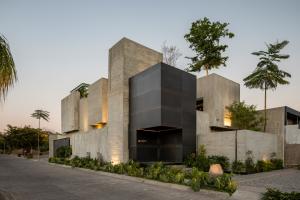
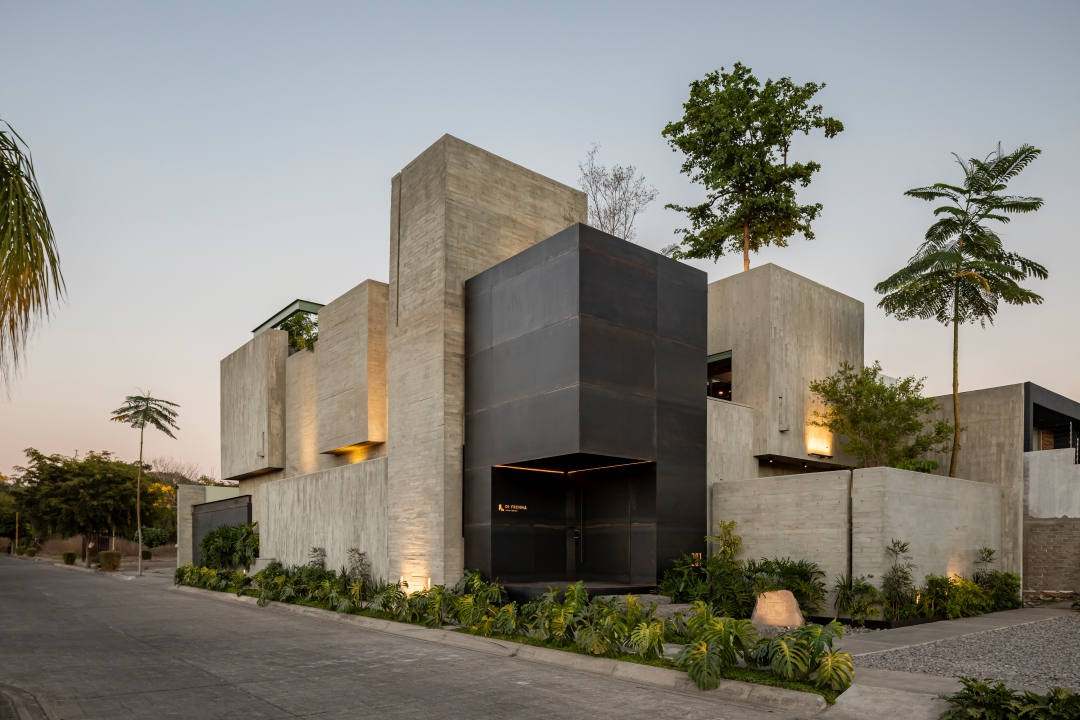
Concrete volumes define the facade of Taller Di Frenna Arquitectos’ studio in Colima, where a dark steel entrance contrasts with textured surfaces and integrated vegetation.
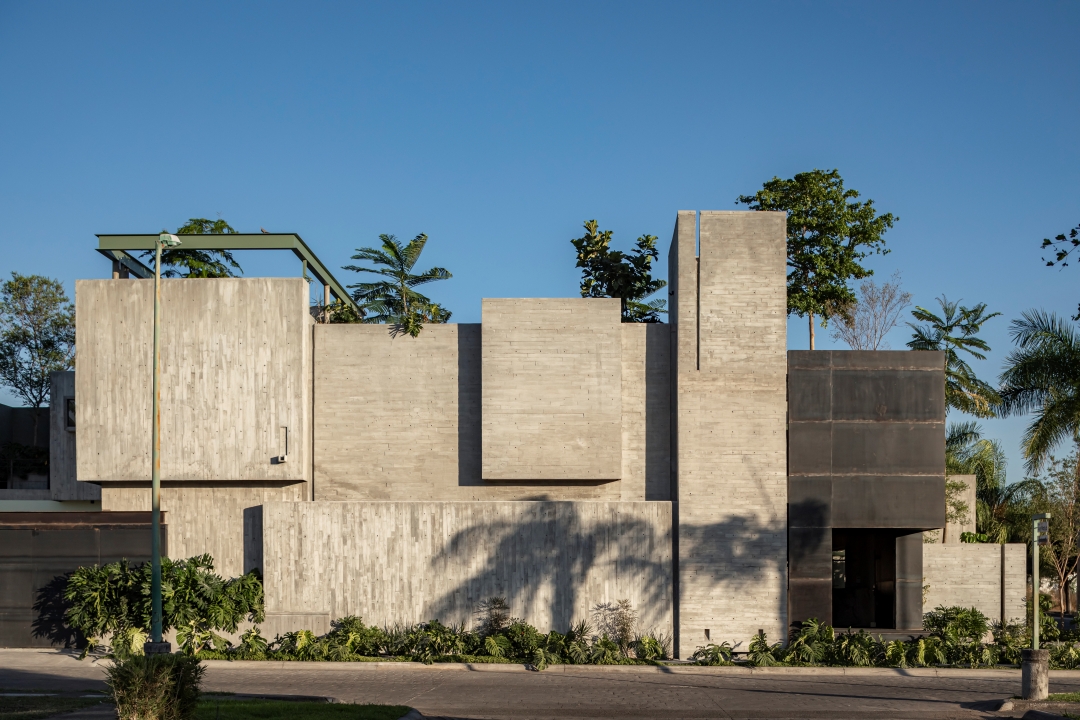
A composition of solid concrete volumes defines the street facade, where geometric projections and a dark steel volume articulate the entrance to the studio.
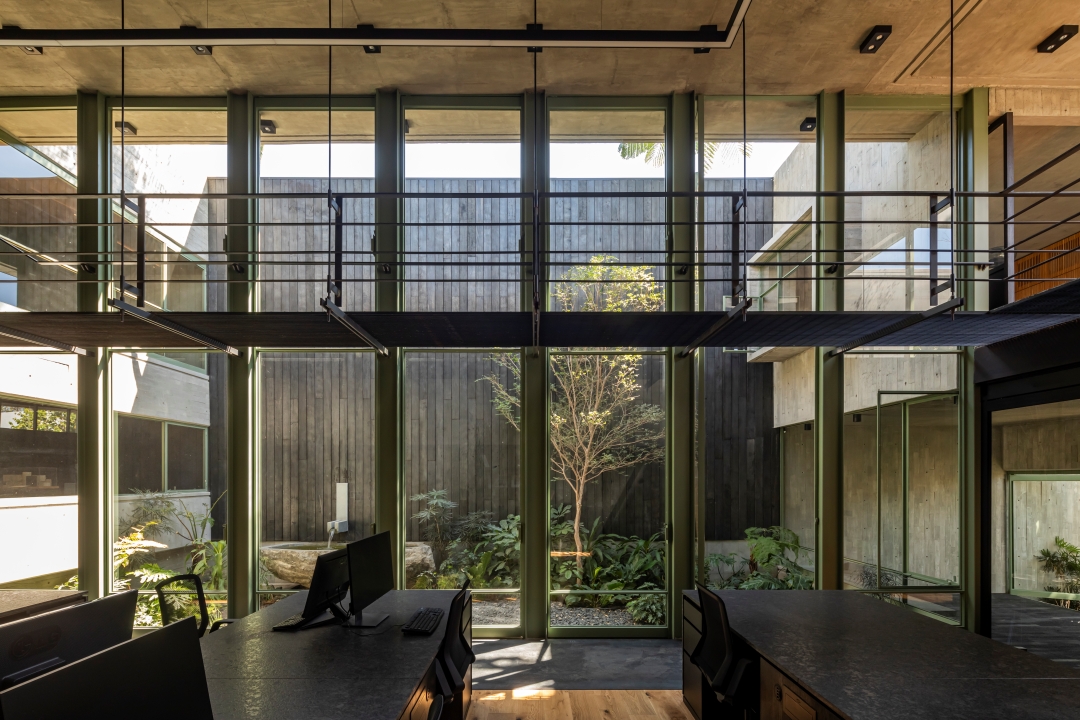
Interior workspace connected to a courtyard, where a suspended walkway and vertical glazing frame natural light, vegetation, and material continuity.
Composition of clear volumes using honest materials like steel, concrete, charred wood, and stone, highlighting texture, durability, and craftsmanship.
COLIMA, COLIMA, MEXICO, March 26, 2026 /EINPresswire.com/ — Summary
The self-designed studio of Taller Di Frenna Arquitectos in Colima, Mexico, emerges as an architectural exploration that goes beyond the conventional notion of an office, becoming an integrated environment for work, experimentation, and the expression of the studio’s design philosophy. Conceived as a creative workspace, the building brings together a diverse program—including work areas, meeting rooms, audiovisual spaces, workshops, and interior courtyards—within a clear composition of volumes that organize both function and spatial experience.
From its inception, the project establishes a fundamental duality: it is both a place for daily professional practice and a laboratory for ideas. In this sense, the building not only accommodates the activities of the studio but also materializes its architectural approach, acting as a built manifesto where materials, construction systems, spatial relationships, and environmental strategies are explored and tested.
A studio as a space for work and exploration
The building was designed to foster interaction among team members and to support the different stages of the architectural process. The programmatic organization reflects this intention: open workspaces encourage continuous collaboration, while meeting rooms and audiovisual areas provide more controlled environments for discussion, presentation, and project development.
The model-making workshop and experimental areas reinforce the idea of the building as a place where ideas are not only conceived but also tested and materialized. This condition transforms the studio into a dynamic environment in which learning, research, and professional practice are closely intertwined.
Beyond its functional role, the project is understood as an extension of the studio’s thinking—a space that stimulates creativity, promotes reflection, and supports the collective construction of architectural knowledge. In this sense, the building becomes more than a container of activities; it operates as an active tool within the design process itself.
Materials and architectural language
One of the most significant aspects of the project is its material approach. The architecture is composed of a series of clean, well-defined volumes, where formal expression is grounded in the honesty of materials. Rather than concealing construction systems, the project exposes them, allowing each element to communicate its structural logic and tactile qualities.
Steel, concrete, charred wood, and stone form a material palette that balances industrial and natural conditions. These materials are not only selected for their aesthetic qualities but also for their durability, maintenance performance, and responsiveness to the local context. The combination of varied textures and finishes creates a layered architectural language, rich in nuance and sensory experience.
This approach reflects a broader design philosophy that prioritizes clarity of form, material authenticity, and the integration of craftsmanship within contemporary architecture. It also demonstrates the studio’s interest in bridging traditional knowledge with modern design processes, producing a dialogue between past and present.
Interior courtyards and spatial continuity
The incorporation of interior courtyards plays a fundamental role in the organization of the project. These open spaces introduce natural light and vegetation into the building while establishing visual and physical connections between different areas.
The courtyards act as spatial mediators that soften the rigidity of the built volumes, creating moments of pause, transition, and contemplation within the overall experience. Through them, a more fluid relationship between interior and exterior is achieved, dissolving boundaries and generating a sense of spatial continuity.
Variations in levels, the interplay of light and shadow, and the presence of vegetation contribute to a dynamic and ever-changing environment. These elements not only improve environmental performance but also shape how users perceive and inhabit the space.
Additionally, the courtyards function as informal gathering areas that encourage spontaneous interaction and collaboration. In this way, they operate not only as environmental devices but also as social catalysts that strengthen the working culture of the studio.
Craftsmanship and construction
The construction process of the building is distinguished by the participation of local builders and artisans, whose work plays a crucial role in defining its final character. Their craftsmanship is evident in construction details, surface treatments, and material finishes throughout the project.
This collaboration reflects the studio’s commitment to integrating contemporary design methods with traditional building knowledge, recognizing the value of manual skill and accumulated expertise. The result is an architecture where technical precision and artisanal sensitivity coexist within a coherent and unified language.
The involvement of local labor not only enriches the project aesthetically but also anchors it within its cultural and geographical context. In this way, the building engages with a broader framework that acknowledges the importance of local resources, techniques, and identities.
Recognition and awards
Taller Di Frenna Arquitectos has received significant national recognition for its architectural work, underscoring the relevance and impact of its design approach. The studio was awarded the Gold Medal at the VI Regional Biennial, Region V Manzanillo 2025, and received first place at the Firenze Entremuros Awards 2025 in the Corporate Interior Design category.
It also earned first place at the Construye Awards 2025 in the Private Infrastructure category and at the Noldi Schreck Awards in the Corporate Spaces category. In addition, the firm has been a finalist in several prestigious competitions, including the AD México and Latin America Awards, the Interceramic Awards, and Obra del Año by Grupo Expansión.
These recognitions highlight not only the quality of the project but also its ability to contribute new perspectives to the contemporary architectural landscape.
Conclusion
The studio of Taller Di Frenna Arquitectos in Colima represents a synthesis of its architectural vision, where space, materiality, process, and context are integrated into a coherent proposal. More than an office building, it is a living working environment in constant evolution—one that fosters creativity, collaboration, and experimentation.
Through an architecture that is both honest and carefully crafted, the project achieves a balance between functionality and expression, between technical rigor and artisanal sensibility. In doing so, it not only responds to present needs but also offers a reflection on architectural practice and its capacity to create meaningful and enduring spaces.
Matia Di Frenna Müller
Di Frenna arquitectis
+52 3121000570
direccion@difrennaarquitectos.com
Visit us on social media:
Instagram
Facebook
YouTube
Legal Disclaimer:
EIN Presswire provides this news content “as is” without warranty of any kind. We do not accept any responsibility or liability
for the accuracy, content, images, videos, licenses, completeness, legality, or reliability of the information contained in this
article. If you have any complaints or copyright issues related to this article, kindly contact the author above.